 how-to
How to Avoid Wedding Rental Delays: A Planning Guide
Table of Contents
- How to Avoid Wedding Rental Delays: Start With Your Timeline
- Wedding Rental Delivery Timeline: What to Expect
- Questions to Ask a Wedding Rental Company
- Wedding Rental Checklist for Delay Prevention
- What to Do If Wedding Rentals Are Late
- Building Flexibility Into Your Rental Plan
- Frequently Asked Questions
Last Updated: October 14, 2026
How to Avoid Wedding Rental Delays: Start With Your Timeline
Wedding day stress multiplies when rentals arrive late, a tent due at 8 a.m. shows up at noon, tables don't match the order, chairs sit in a truck while guests arrive.
Most rental delays are preventable, they happen because couples don't ask the right questions upfront or confirm details as the date approaches.
This guide covers how to avoid wedding rental delays: the timeline, the questions to ask, and what to do if problems occur.
Wedding-Day Timeline Planning Essentials
Your timeline dictates when vendors arrive, when setup happens, and when guests see the result. Map your entire day:
- Getting ready time: 2-3 hours before ceremony
- Hair and makeup: Typically 1-2 hours per person
- Family portraits: 30-60 minutes before or after ceremony
Your rental company needs this timeline to schedule delivery, setup, and pickup. Share it when you book, not a week before.
Common Causes of Schedule Delays
Most delays stem from five problems:
Unclear delivery windows. You book a tent for Saturday without specifying Friday afternoon or Saturday morning, so the company assumes one thing and you assume another.
Poor venue communication. If the rental company doesn't know your venue's rules on loading dock access, parking, and setup times, they lose hours.
Last-minute changes. Adding ten chairs two weeks out shifts inventory, so what was available becomes unavailable.
Incomplete order details. An order listing "tables" without shape, size, or color means the wrong tables show up.
Procrastination on booking. Popular companies book up months in advance; waiting until six weeks out limits your options.
Wedding Rental Delivery Timeline: What to Expect
Rental companies route trucks by geography, item type, and setup complexity. Knowing the logic lets you negotiate a better slot.
Booking Lead Times and Availability
Most rental companies need 4-8 weeks of notice for weekend weddings, and May through October dates book fastest, summer weddings should book by late winter. Tents book up first; tables, chairs, and linens have more availability; specialty items like lounge furniture, dance floors, and lighting need the longest lead time.
A few operational realities worth knowing:
- Weekend deliveries are routed Thursday through Saturday. Many companies deliver Thursday or Friday for Saturday events. If your venue allows Friday delivery, you'll often get a better window and lower fees than a Saturday-morning drop.
- Holiday weekends compress availability. Memorial Day, Labor Day, and the last two weekends of September are tightest. Book those dates 3-4 months out.
- Deposit timing matters. Availability is held by a signed contract and deposit, not a quote. Wait a week to decide and the tent you wanted may be gone.
How Delivery Windows Are Actually Assigned
A delivery window is a two-hour range, "Friday 2-4 p.m." or "Saturday 7-9 a.m.", not an exact time, because the dispatcher builds the route the night before based on:
- Geographic clustering. Trucks serve customers in the same part of town in sequence, so a venue far from other stops may get a wider or less convenient window.
- Setup complexity. A tent install takes 2-4 hours and often a crew; a tables-and-chairs drop-off takes 15 minutes. Complex installs usually get the earliest slots.
- Venue access restrictions. A venue allowing deliveries only between 10 a.m. and 2 p.m. pushes you into a narrower window.
Tracking the Truck and Confirming Arrival
Most rental companies don't offer GPS tracking, but they can call or text when the truck leaves the previous stop. Ask at booking:
- "Will the driver call or text when they're 30 minutes out?" If yes, get the driver's number or confirm the dispatcher will relay it.
- "Who do I call if the window is closing and I haven't heard anything?" Get the dispatch line, not just your sales rep.
- "What's the after-hours number if the truck is late on a Saturday evening?" Ask for it in writing.
On delivery day, have one designated person, you, your planner, or a trusted family member, on site and reachable by phone for the entire window.
Venue Logistics That Determine Whether the Window Is Achievable
Whether the truck can get in, unload, and set up on time depends on venue logistics you must confirm and communicate in advance:
- Loading dock or delivery zone. Is one reserved for you? Shared docks can queue up if another event is loading in.
- Truck access and surface. Can a box truck drive on the lawn, or must it stay on pavement? Soft ground after rain can turn a 20-minute unload into an hour.
- Gate width and height. A standard box truck needs roughly 10-12 feet of clearance; a tent truck may need more.
What a Realistic Delivery Day Looks Like
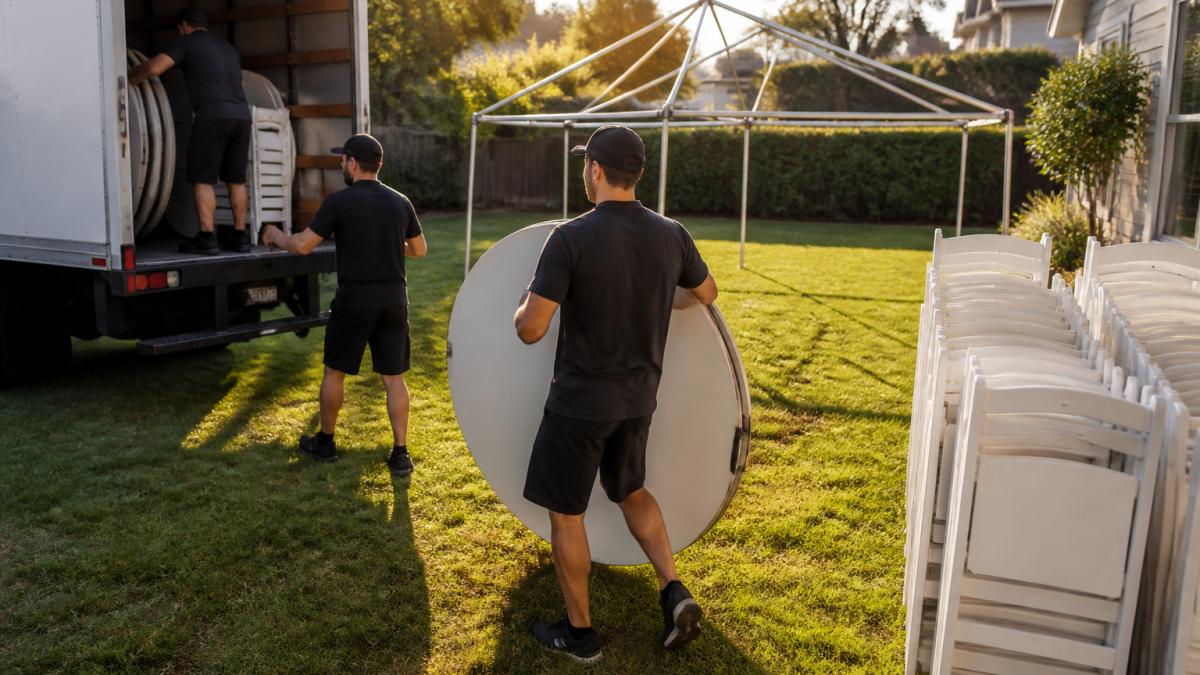
A typical Saturday wedding with a Friday drop-off: the truck arrives within the window, the crew unloads tables, chairs, and linens in 30-60 minutes, and a separate crew returns Saturday morning for tent and lighting setup. If everything is delivered Saturday, expect an early window, often 7-9 a.m., so have someone on site by 6:45 a.m.
Questions to Ask a Wedding Rental Company
Ask these questions before you sign a contract:
Vendor Communication and Coordination
Ask how the company communicates as the event approaches, call, email, or text, and how far in advance they confirm delivery.
Ask who your point of contact is and whether it stays the same throughout planning; one consistent contact prevents lost messages.
Ask whether they coordinate with your caterer or florist on timing and space, or expect you to manage all vendor communication.
Confirming Rental Orders and Details
Ask for written confirmation listing every item, quantity, color, size, and price. Don't rely on verbal agreements.
Ask about substitutions: if your first-choice color isn't available, do they swap in the closest option, and do they ask permission first?
Ask about delivery, setup, and breakdown fees, some include them, others charge separately. Confirm all costs before you book.
Ask about cancellation and postponement: if your wedding is rescheduled, can you move the rental date, and is there a fee?
Wedding Rental Checklist for Delay Prevention
Use this checklist to prevent delays.
Inventory Verification and Substitutions
Two weeks out, call to confirm your complete order. Verify:
- Item types (round tables, not rectangular)
- Quantities (20 chairs, not 15)
- Colors and styles (white linens, not ivory)
Ask for a final confirmation email with all details, and print it for your wedding binder. Confirm again one week out, it feels repetitive but catches mistakes before they become problems.
Ask about backup inventory: if a table arrives damaged, is a replacement available, and what's the swap process?
Setup and Breakdown Scheduling
Confirm exactly when setup starts, some companies come the afternoon before, others the morning of.
Ask how long setup takes; most tent and table setups run 2-3 hours, which helps you plan your getting-ready timeline.
Confirm who handles breakdown and whether you need to be present.
Ask about pickup timing, immediately after the event or the next day, and if it's the next day, whether someone must stay overnight with the equipment.
What to Do If Wedding Rentals Are Late
Even with airtight planning, trucks break down, drivers get lost, and weather closes roads. What separates a recoverable delay from a ruined reception is whether you built escalation and remedy terms into the contract before signing, and what you do in the first 30 minutes after a window closes.
Contract Terms That Protect You Before Anything Goes Wrong
Most rental agreements protect the rental company, not you. Before signing, read the delivery, remedy, and cancellation clauses and get these specifics in writing:
- A defined delivery window, not a day. "Saturday" is not a commitment; "Saturday between 7 and 9 a.m." is. Ask them to write the window into the contract.
- A late-delivery remedy. Ask: "If you miss the window by more than two hours, what do I get?" Common answers include a waived delivery fee, a percentage credit, or a same-day rush replacement. Get it in writing, a refusal to commit tells you something about their operation.
- A substitution clause with your approval right. The contract should require your written approval, text or email counts, before any item (color, size, style) is substituted. Without this, a company can legally swap ivory linens for white and call it equivalent.
The First 30 Minutes After a Missed Window
When the window closes and no truck has arrived, act fast before the delay cascades into your ceremony:
- Call the main line, not your sales rep's cell. The dispatch line is staffed during delivery hours; your rep may be off. Ask for the dispatcher on duty.
- Ask four specific questions. Where is the truck now? What is the new ETA? What caused the delay? What is the company doing to make it right? Write down the answers with the time and the name of the person you spoke with.
- Get the new ETA in writing. Ask them to text or email the revised window. A text timestamp is your evidence if you later dispute a fee.
- Escalate at the 60-minute mark. If the new ETA slips again, ask for a manager or owner by name: "My ceremony is at 4 p.m. and the tent is not here. I need a decision now on whether you can deliver or whether I need to source a replacement."
- Document everything. Keep a running log of time, person, and what was said. If you dispute a charge or file in small claims court, this log is your case.
When to Cut Losses and Source a Replacement
At some point, waiting costs more than replacing:
- Nonessential items (decor, lounge furniture, extra lighting): If they're more than 90 minutes late and your setup window is closing, cancel them verbally, document the cancellation, and move on. Dispute the charge later.
- Essential items (tables, chairs, tent): If the truck is more than two hours past the window with no confirmed ETA, start calling backup suppliers. Save two or three local rental companies' numbers in advance, and ask during booking season whether they keep same-day emergency inventory.
- Tent specifically: A late tent is usually a weather-safety issue, not just an aesthetic one. If the tent isn't up and rain is forecast, activate your indoor backup plan rather than waiting.
Filing a Complaint or Disputing a Charge
If the company fails to deliver and refuses to refund:
- Credit card chargeback. If you paid by card and the company materially failed to deliver what you contracted for, you can dispute the charge under the Fair Credit Billing Act, generally within 60 days of the statement date. Keep your contract, confirmation emails, and call log.
- State consumer protection office. Every state has a consumer protection division under its attorney general. Filing is free and creates a paper trail, though it won't get your money back quickly.
- Better Business Bureau. Not a government agency and not binding, but a complaint sometimes prompts a company to settle to protect its rating.
Building Flexibility Into Your Rental Plan
The best protection against delays is flexibility. Rigid plans break when problems occur; flexible plans adapt.
Build buffer time into your schedule.
Keep your planner or coordinator informed of all rental details so they can manage vendors and timing while you enjoy the day.
Wedding rental delays are stressful, but most are preventable. Start with a clear timeline. Ask detailed questions. Confirm everything in writing.
At Backyard Events Rental, we provide tents, tables, chairs, and lighting. Our team communicates clearly throughout planning and confirms all details before your event, so you get reliable equipment and a point of contact who answers your questions. Book now and host your backyard wedding with confidence.
Frequently Asked Questions
How far in advance should you book wedding rentals to avoid delays?
Booking 2-3 months ahead is standard for peak seasons; 6-8 weeks minimum for off-season events. Early booking secures your preferred delivery date and gives the rental company time to confirm availability and coordinate logistics with your venue. Last-minute bookings (under 3 weeks) risk limited inventory and scheduling conflicts that can push your delivery window later than desired.
What details should you confirm with a wedding rental company to prevent delays?
Confirm your event date, delivery window (exact time range), setup location and venue access instructions, quantity and specifications of each rental item, pickup date and time, point of contact on wedding day, and any delivery restrictions. Request written confirmation of all details in your rental order. Ask about their escalation procedure if they run late and whether your contract includes delay protections or compensation.
What should you include in your wedding rental checklist?
Your wedding rental checklist should cover: booking confirmation and order number, delivery and pickup times, setup and breakdown timeline, complete inventory list with quantities, venue access details and loading area location, weather contingencies, point of contact and phone number, backup rental company contact (if applicable), and a final inventory verification procedure 24 hours before delivery. Include responsibility assignments for who confirms what with the rental company.
What should you do if wedding rentals arrive late on your event day?
Call your rental company's emergency contact immediately with your order number and exact time of arrival. Ask for a revised ETA and whether they can expedite setup. If significantly delayed, invoke your contract's delay clause (if included). Have a backup plan ready: prioritize essential items (seating, tent shelter), delay ceremony start if needed, or use alternative solutions temporarily. Document the delay with photos and times for potential compensation claims.